
I come out and look at it myself
I measure the rise from the ground to your door and check what the old steps sit on. You get a straight answer on precast or poured, and an estimate built from what your entry actually needs.
Cracked, sinking or uneven front steps? We build new concrete steps on real support, laid out so every step comes out even.
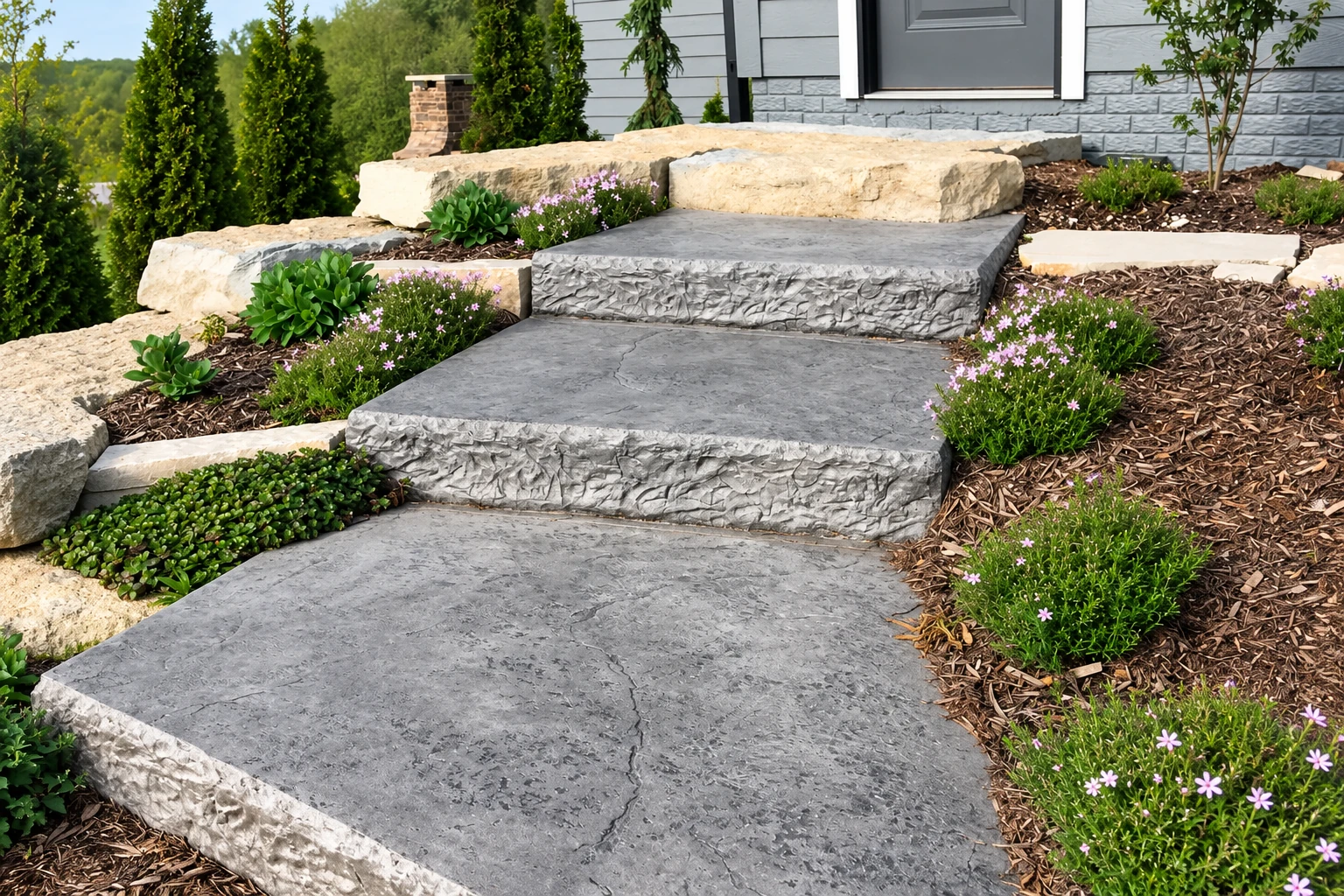
Concrete steps construction in Little Rock means building a new set of steps, precast or poured, on solid support, so every step is the same height and the set doesn't sink or pull away from your house.
Most calls start with steps that are cracked, chipping at the edges, pulling away from the house, or sunk so one step sits taller than the rest. Concrete steps are built in forms. They rest on the ground, tie into a landing or the foundation, or span from one support to another, and how yours are held up decides how they get built. When old steps sink, it's usually because somebody set them on loose dirt.
The price moves with how many steps you need, precast or poured, the size of the landing and how much old concrete has to come out. That same choice drives the schedule, because precast gets set in place while poured needs forms and time to cure. Any permit review your job needs adds to it. I'll give you your own number and a plan at the estimate, once I've seen your entry.
You deal with me from the first look to the last walk-through. Here's who does what.
I measure the rise from the ground to your door and check what the old steps sit on. You get a straight answer on precast or poured, and an estimate built from what your entry actually needs.
Our crew does the dig, the forms and the pour, and I run the job on site. I check the base and forms myself before the concrete truck shows up, because you can't fix that part once it's poured.
We've been building concrete work since 2020, and we're fully licensed and insured. When the job's done I walk the finished steps with you. Your satisfaction, guaranteed.
First we break out the old steps and dig down to firm ground. Steps need real support, so we set them on footings or tie them to your landing or foundation. Even a small decorative set needs more than fill that was never packed down. Before we build a single form, we lay out the full rise, the total height from the ground to your door. Codes can set how tall and deep each step is and how big the landing has to be, and a small miss repeated over several steps throws off the top or bottom one. Then we set the steel, pour, and give the treads a broom finish, a light brushed texture, so they grip in the rain instead of going slick. If the budget's tight, spend it on the base, not the finish. Nobody sees the base, and it's what keeps the steps from sinking.
Steps that tie into the house lean on what's already there, so it helps that we also do slab foundation building and foundation installation. When I look at your entry, I'm checking the slab or foundation your new steps will hook onto, not just the steps.
Here's what you'll see from the day we start to the day you're using the front door again.
Once the old steps come out, that entry is out of use, so plan on the garage or back door for a while. I'll tell you at the estimate which door we'll be blocking.
We break up the old steps, haul them off and dig until we hit ground that won't move. That's usually when we find out what was really holding up the old set.
The forms go up to the layout, the steel goes in, and the concrete gets poured and finished. Precast skips most of this, since those steps are set in place instead of poured.
Poured concrete has to cure, which is the wait while it hardens to full strength. Keep heavy loads and planters off until we tell you it's ready.
Send the form or call (501) 274-1092, and we'll get back to you within one business day. I'll come out, measure your entry and talk through precast or poured with you. The estimate is free and comes with no obligation.
(501) 274-1092Across the US, precast or poured concrete steps usually cost about $100 to $500 per step, installed. For poured steps, the framing and the rebar or mesh, the steel that strengthens the concrete, are typically part of the material cost. Your own number comes from the estimate after I've seen your entry.
Precast usually makes sense for a standard entry on a tighter budget, and poured is the better pick when you need an odd size or a wider set. Precast steps cost less because they're hollow and easier to put together. Poured steps cost more but come in a much larger range of sizes. I'll tell you which one fits when I see your door.
With proper care and upkeep, concrete steps last 30 to 40 years. Watch for one part settling more than the rest, because even a small drop can trip someone, so get it fixed early instead of waiting.
The city's Building Codes Division issues construction permits in Little Rock and handles plan review and inspection. Whether your steps need a permit depends on the job, so I check with the city or county office for your address, and we handle the permit paperwork when one is required. Lots in the floodplain have an extra review first, which I cover below.
If any part of your lot is in the regulatory floodplain, the city's Floodplain Manager has to review and approve any kind of work there before a grading or building permit is issued. If you think you're in it, tell me when you call, because that review comes before we can dig.
The ground here matters too. Mapped soils across Pulaski County range from low to very high shrink-swell, which means some of the clay swells when it's wet and shrinks when it dries out. That's a county map, though, and it can't tell you what's under your house. Many of those problems can be handled with engineering before you build, which is why we set steps on footings or tie them in. We're based in Little Rock and do the same work across the cities around it, like North Little Rock and Sherwood. If you don't see your city on the site, call and ask.
Call (501) 274-1092 or use the form, and a couple of photos plus a count of your steps lets me show up already thinking about what your entry needs.
If your steps are sinking or crumbling, tell us about them and I'll come take a look.
Tell us about your project